A traveller on the Silk Road

Spoiler alert! One of the mysteries not explained until the end of the second book of the Wisdom of Rhiannon series is Geraint’s origin.

Read no further if you would prefer to find out through the story in the book, otherwise, the answer follows below.

In fact in one of those mysteries that all authors seem to experience, even this author, is that often the story somehow tells itself. Nowhere in the author’s mind was the so-called “back-story” to the history of Geraint (one of the central characters). That is until the story decided to reveal it, through the device of a historical article concerning one of Caesar’s huge extravagances. His purchase of a large quantity of silk.

At the time of Caesar there was a huge controversy in Rome over the cost and use of silk, especially by Roman women.

In vain the Senate issued several edicts to prohibit the wearing of silk, on economic and moral grounds.  We are told that the importation of Chinese silk resulted in a huge outflow of gold, and silk clothes were considered to be decadent and immoral. To quote Seneca the Younger (c. 3 BCE- 65 CE, Declamations Vol. I):

I can see clothes of silk, if materials that do not hide the body, nor even one’s decency, can be called clothes… Wretched flocks of maids labour so that the adulteress may be visible through her thin dress, so that her husband has no more acquaintance than any outsider or foreigner with his wife’s body. 

He was not alone, Pliny the Elder (23- 79, The Natural History), wrote:

The Seres (Chinese), are famous for the woolen substance obtained from their forests; after a soaking in water they comb off the white down of the leaves… So manifold is the labour employed, and so distant is the region of the globe drawn upon, to enable the Roman maiden to flaunt transparent clothing in public. 

But in his way, Caesar was even more extravagant, purchasing a huge quantity of silk and using it to shade the spectating Romans as he was carried triumphantly through the City to celebrate one of his triumphs.  Even his own soldiers were critical of his expenditure, complaining that it was money that could have been better spent on rewarding them.

And so the seed was planted. Who conveyed the silk from China to Rome? Who would have guarded it on its long journey? And so the back-story was born.



The Tower of the Winds

What a wonderful title for a tower, and no, it’s not found in the Lord of the Rings trilogy. Instead it stands inside the Vatican and was built to answer, in effect, the question, how long is a day. The answer that they came up with was not 24 hours, but rather 23 hours and fifty six minutes.
The Tower of the Winds was built between 1578 and 1580 as a means leading to the reform of the Julian calendar which had been in use since 45 BCE. At midday the sun shines through a hole in the wall, and illuminates a large sundial inscribed on the floor of the tower, and thus provided the means of calculating the true length of a day.

towerofwinds

The Gregorian calendar that followed introduced the leap year as a means of compensating for the real length of a day.
As the photo shows, the Tower is richly decorated, and is one of the highest points in Vatican City.
But predating that is an even older Tower of the Winds, to be found in Athens. I can do no better than quote from the Athens Tourist Information web site, viz:

Torre_dels_Vents_d'Atenes

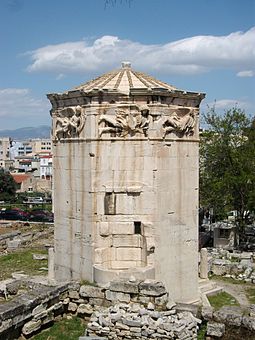
The Tower of the Winds is found in the Roman Agora of Athens, between the quarters of Plaka and Monastiraki. This is among the most famous sights of Athens. A 12-metre-tall structure with a diameter of 8 metres, this tower has octagonal shape. It was made of fine Pentelic marble probably around 50 B.C. by the Greek astronomer Andronicus of Cyrrhus. This tower has many uses in the ancient times. It was originally constructed as a time piece, that is to estimate time, based on the position of the sun. It was also used for weather indicating and forecasting. The tower features a combination of sundials, a water clock and a wind vane. In fact, its frieze depicts the eight wind deities according to their direction: Boreas (N), Kaikias (NE), Eurus (E), Apeliotes (SE), Notus (S), Livas (SW), Zephyrus and Skiron (NW). Source: http://www.greeka.com

Celts on the Silk Road 3,000 years ago

The following is a partial summary of a longer article to be found in Celtic Life International (https://celticlife.com/the-chinese-celts/)  and the Independent newspaper, (https://www.independent.co.uk/news/world/asia/a-meeting-of-civilisations-the-mystery-of-chinas-celtic-mummies-5330366.html). Perhaps it should be of no surprise that the then nomadic Celts found their way to the far north part of the Silk Road in China.  Today we see only vast distances, easy to fly over, difficult to walk across, but when walking was your only option, and it is part of your way of life, what is distance but time travelled?

tarim_42-570x328[1]

There is no doubt that he is a Celt. The man’s hair is reddish brown flecked with grey, framing high cheekbones, a long nose, full lips and a ginger beard. When he lived three thousand years ago, he stood six feet tall, and was buried wearing a red twill tunic and tartan leggings. His DNA confirms it. 

What is extraordinary is that his body was discovered  – with the mummies of three women and a baby – in a burial site in the sands of the Taklamakan Desert in the far-flung region of Xinjiang in western China,  In the language spoken by the local Uighur people in Xinjiang, “Taklamakan” means: “You come in and never come out.”

DNA testing confirms that he and hundreds of other mummies found in Xinjiang’s Tarim Basin are of European origin. We don’t know how he got there, what brought him there, or how long he and his kind lived there for. But, as the desert’s name suggests, it is certain that he never came out.

One of the women who shared the tomb has light brown hair which looks as if it was brushed and braided for her funeral only yesterday. Her face is painted with curling designs, and her striking red burial gown has lost none of its lustre during the three millenniums that this tall, fine-featured woman has been lying beneath the sand of the Northern Silk Road.The bodies are far better preserved than the Egyptian mummies, and it is sad to see the infants on display; to see how the baby was wrapped in a beautiful brown cloth tied with red and blue cord, then a blue stone placed on each eye. Beside it was a baby’s milk bottle with a teat, made from a sheep’s udder. Analysis has shown that the weave of the cloth is the same as that of those found on the bodies of salt miners in Austria from 1300BC.

Strange star flashing in the Heavens

scholtz star
Artist’s conception of Scholz’s star and its brown dwarf companion (foreground) during its flyby of the solar system 70,000 years ago. The Sun (left, background) would have appeared as a brilliant star. The pair is now about 20 light years away. Credit: Michael Osadciw/University of Rochester.

Currently, Scholz’s star is a small, dim red dwarf in the constellation of Monoceros, about 20 light years away, and now moving away from us. However, about 70,000 years ago, it just grazed the outer reaches of the solar system as it wandered by, accompanied by its brown dwarf companion.
At the closest point in its flyby of the solar system, Scholz’s star would have been a 10th magnitude star – about 50 times fainter than can normally be seen with the naked eye at night. But because it is magnetically active, such stars can “flare” and briefly become thousands of times brighter. So it is possible that Scholz’s star may have been visible to the naked eye by our ancestors 70,000 years ago for minutes or hours at a time during these flaring events.
What would our ancestors have made of this stranger in the heavens? What would we have made of it a thousand years ago if it were passing by us then and not 70,000 years previously?

An artist’s concept of Scholz’s star with its brown-dwarf companion in the foreground during their flyby of the solar system 70,000 years ago. The sun would appear as a bright star from the pair (left background). Credit: Michael Osadciw/University of Rochester

Celts, Silk and Druidic Knowledge

Even in the 6th century BCE there is evidence of silk being worn by the Celts in Europe. It has been found mongst the many rich grave goods discovered at Hallstatt in Germany.  The silk cloth must have felt exquisite compared to the standard wool and linen usually worn. There were many other fine grave goods discovered often imported from sites across Europe including for example coral, amber and even black shale bracelets from Britain.

The interesting point though is how extensive the trading routes were, even in the 6th century BCE, and doubtless it was not only silk and other goods that made their way across many thousands of miles. Along with the exchange of good there would be the exchange of knowledge – tales of far distant places, the religions practised there, the latest fashions even – and no doubt the traders would have been accompanied by priests and others curious to explore the worlds around them.

IMGP5257_1024

Authors, especially Peter Berresford Ellis in his book The Druids, have pointed out many similarities between what is known about the religion practiced by the Druids and that of Hinduism.  And with the evidence of trade with China as well it all paints an interesting backdrop to the religion of the Druids.  Sadly, fascinating as these connections are, we can never know the reality, but given the evidence of how far goods – and therefore knowledge – travelled who knows?

Massacre of the Druids – as told in place names.

obj135geo146pg21p2[1]In AD60 the Roman general Paullinus stood on the banks of the Menai with a Legion of the XIV Gemina. On the opposite bank were thousands of Celts including many Druids, for this was the island of Anglesey as it is now called. Mona as it was then known, was the home of the Druids, the centre of Druidic teaching.

The story of the battle that took place is told elsewhere, but suffice it to say that the Romans successfully crossed the Menai and defeated the opposition.  Then the massacres began. The names of various places on the Island bear mute remembrance to the slaughter that took place, despite the passage of more than two thousand years.

Place names such as Bryn-y-Beddau, the Hill of Graves, Plas Goch, the Red Place, and most graphically,  the two fields still known as the Field of the Long Battle and the Field of Bitter Lamentation. The power and teachings of the Druids were never to recover from the disaster that occurred on Mona, though Ireland, unconquered by the Romans, was to remain a haven for the Druids until the spread of Christianity.

My 2,000 year old coin

CoinsIt sits on a shelf, in a little pill box. I rarely look at it, yet somehow I am always aware of its presence. Not in a good or a bad way, but as though gravity is slightly heavier near to it. Tonight I took it out of its box, and viewed it again. Compared to a modern coin, it’s tiny, light and not well finished.
Yet what holds me is that 2,000 years ago, someone minted this coin, someone carried this coin with them, perhaps it changed hands many times, and I guess someone lost this coin, who knows, and somehow, it found its way to my shelf. In geographical terms, a short journey from Norfolk to Yorkshire, in terms of time, a journey that few artefacts survive.
Certainly the kingdom of the Catuvellauni, whose coinage it was, has long disappeared in the sea of history, and of those who live in its lands today there will be few who will have heard of this long lost kingdom. Yet a coin survives to tell a tale and to speak of people who lived, loved, fought wars, and vanished, although no doubt the children of their children’s children still live, love and walk in the footsteps of their ancestors.
And the coin? Does history, or time, imbue it with a power, a presence, or is it my imagination?

Glastonbury

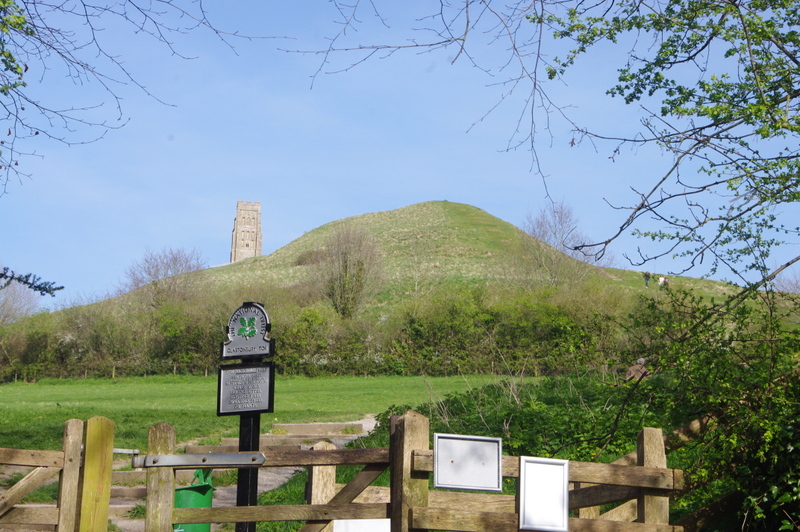
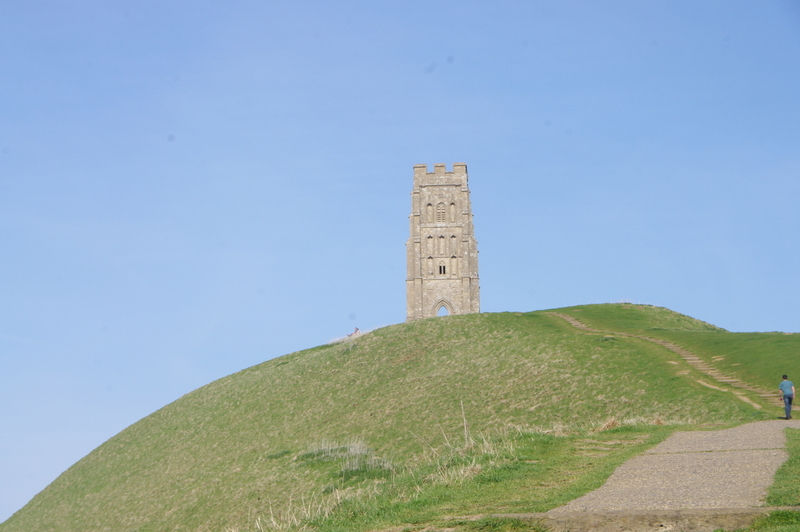
IMGP5647Otherwise known as the Isle of Avalon. A strange, mysterious place, even now the smell of incense pervades the air and mostly defeats the traffic fumes. Once upon a time it really was an Island, secured by the surrounding bogs and water courses that surrounded it. But gradually the bogs were drained for agricultural purposes and the Island became just another part of the landscape, albeit topped with a most unusual hill, known as Glastonbury Tor.
IMGP5666

This in turn is topped by a medieval tower that adds to the striking profile of the Tor. Legend has it that beneath the Tor exists the realm of Gwyn ap Nudd, the king of the Tylwyth Teg or “fair folk” and ruler of the Celtic (especially Welsh) Otherworld. Another tradition portrays him as the leader of the Wild Hunt, in which he leads a pack of supernatural hounds known as the Cŵn Annwn to harvest human souls. In Welsh folklore, to hear the baying of Gwyn’s hounds was a portent of imminent death in the family.

And there is much more to Glastonbury. A place where seventy differnt faiths are practised, a place of piligrimage that dates back two millenia, of sacred springs, and a high street that offers some of the most unique products, from gongs to healing, from spells to tarot readings.

A mix of photos of the Chalice Well and the stream that runs from it, together with photographs of a shop on the main street and an arcade.

Julian’s Bower

Version 2

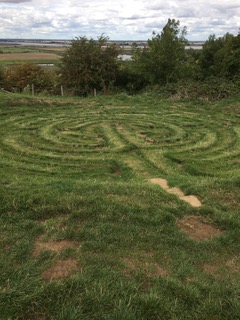
Julian’s Bower is a turf maze found in Alkborough in North Lincolnshire. Unusually there is a carving of the maze in the stone floor of the porch of the nearby church. (There is also a copy on the East window of the church, and on a gravestone in the nearby cemetery).
As the photo just shows, the view from the maze is stunning, and on a fine day reveals the countryside for many miles around. But why a maze, and what purpose did they serve?
The idea of the maze goes back as far as the legend of Theseus and the Minotaur. Theseus, son of King Aegeus of Athens. He used a ball of wool given to him by Ariadne to mark his way through the labyrinth of the Minotaur in Crete, where he slayed the monster and retraced his steps with the aid of the thread and so to safety.
Perhaps the best theory is that this maze was carved by a small cell of monks who lived in the area until the 13th century, and that it represents the path through life to heaven. This would fit in with the carving in the porch of the church.
It is also thought that mazes were also used for penitential purposes, so sinners would be made to trace the path upon their hands and knees. Yet another theory is that mazes were a way to confound the Devil, who could only travel in straight lines.
Turf mazes are all unicursal, that is, they have no choices or branches, and there are a number still to be found across England. The dates for their creation are all guesses, since because they are turf, they have to be renewed frequently, or they disappear, as many presumably have.

The Rudston Monolith

OLYMPUS DIGITAL CAMERA

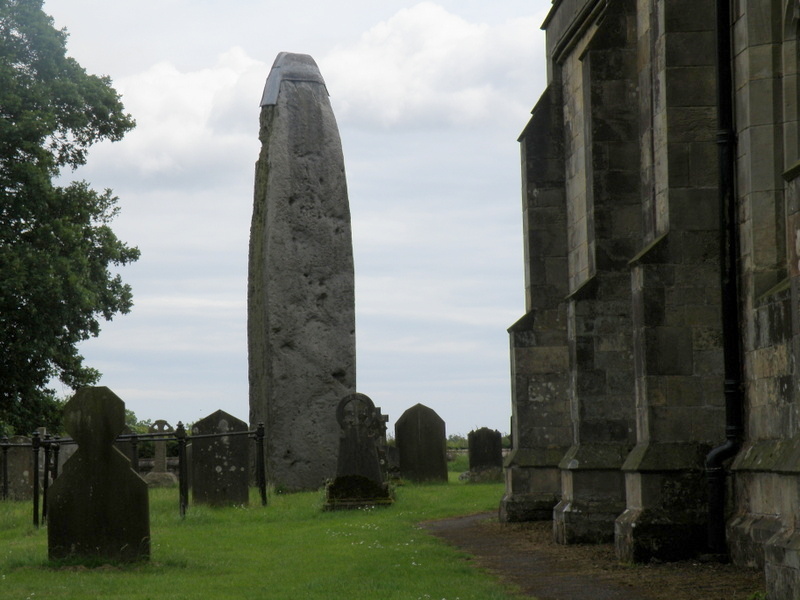
It is both surprising and stunning. As you come around the edge of Rudston church, there is the monolith, the tallest in England at 7.6 metres, with reputedly the same length buried under the ground.. It is so unexpected that the stranger can only stop and admire. Of course it predates the church by many thousands of years, and it’s presence says something very clearly.

This is a holy site, and has been for millennia. It is one of many henges, standing stones, circles and tumulus that still litter the landscape, that speak of a past now lost to us. Their silent witness tells of people who cared enough to put huge effort into constructing and erecting monoliths such as this one. But why? We can only speculate. Speculate not only about the purpose, though that is grand enough. But who organised the fetching of the stone that forms it? Who fed the labourers, who had the knowledge and skill to erect a structure that has lasted thousands of years? They clearly had the leadership, resources and commitment not out of place in a modern company. Reflect on the fact that the monolith weights some 26 tons, and was transported a distance of 10 miles to its present site, and ask yourself the question, how far have we really progressed today?

Design a site like this with WordPress.com
Get started