Entanglement – we are all linked.

If anyone wants proof that we have a long way to go in understanding the way the Universe works, look no further than entanglement. Einstein hated it. He called it “spooky action at a distance”, trying to prove with others that it was a flaw in the theory of quantum physics.

It’s nothing to do with earphones getting tangled, annoying though it can be. Here we are talking about events at a quantum level which defy what we consider as reality.

At some deep level, it appears to be a fundamental component of the Universe. “Entangle” two photons by producing them together, change one, the other changes instantly, no matter how far the distance between them.  It has been proved to work time after time. And not only that, it works instantly, over vast distances.  Even though as Einstein showed, you cannot travel faster than the speed of light, disruption of entanglement is somehow an instant process.

Physicists can’t explain it. Well, that’s not strictly true. There is one explanation, but it’s such a mind boggling explanation, that most people shy away from it.

The explanation – that everything is already connected! You, me, the stars, every atom in the whole Universe.

And I rather like that!!

Fogou – what are they?

In Cornwall they are known as Fogou, meaning in the Cornish language, Caves. (In Cornwall alone it is estimated there are over 2,000 fogous). In Scotland as Earth houses, though they are more usually called Souterrains (from the French, under the ground). Widely found across Britain, Ireland and Europe. Some can be quite complex tunnels, but usually they consist of an underground passage or tunnel with a narrow opening at the far end to just let a small amount of light through, but certainly not wide enough to exit through.

So what purpose did they serve? No one knows, we can only speculate. Places of refuge, of storage, or ritual shrines?

Above are two photographs of a Souterrain visited in Scotland on the Isle of Skye. In photograph 1 you might just distinguish a pair of wellies, (yellow, top right), put there to indicate that this particular souterrain was flooded.  Which added considerably to the atmosphere as I and my companion went down and into it.  As with most souterrains, the floor sloped upwards toward the end of the passage providing a little space to sit above the water for one of us at least.

And as for the question asked at the beginning? I am no wiser, but it didn’t feel as though this particular passage would serve any purpose as a storage means, especially given the effort taken to construct it. A place of refuge. Too low, too narrow too cramped to hide for long from attackers. A place with a ritual purpose? For some kind of initiation process perhaps? Sat in the gloom of a Neolithic construction some 2-3,000 years old with the water lapping about, most certainly!

It is as it is meant to be

IMGP5180_face0

And it was thus.
A Retreat. The mix of lack of sleep, inner contemplation, the challenge of solving/understanding a Koan. A process anointed by the passage of centuries, a path followed by – perhaps millions? – over the centuries.
Somewhere on my own personal journey on that Retreat I understood something deep, profound, something moved me to tears of joy. An insight, no, deeper than that, an understanding that this IS the way the Universe works.
It is, as it’s meant to be, for better, for worse in our short term view, but it is as it is meant to be.

Begin it now!

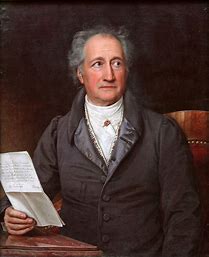
goethe
Johann Wolfgang Von Goethe 1749 -1832

Until one is committed, there is hesitancy, the chance to draw back. Concerning all acts of initiative (and creation), there is one elementary truth, the ignorance of which kills countless ideas and splendid plans: that the moment that one definitely commits oneself, then Providence moves too. All sorts of things occur to help one that would never otherwise have occurred. A whole stream of events issues from the decision, raising in one’s favour all manner of unforeseen incidents and meetings and material assistance, which no man could have dreamed would have come his way. Whatever you can do, or dream you can do, begin it. Boldness has genius, power and magic in it. Begin it now.
One of many pearls of wisdom from Goethe.

Magic or medicine?

IMGP5041_face0Writing “The Wisdom of Rhiannon” was a test of my beliefs. I was trained as a physicist which fashioned me to see the physical world in which we live in a certain way. So I was challenged in trying to determine what “powers” did the Druids have; any, or was it trickery, or a good knowledge of the natural world, for example, in predicting eclipses? What was the nature of ancient knowledge? Certainly there is evidence of quite remarkable medical knowledge, for example, trepanation, a delicate surgical technique for making a hole in someone’s skull, with evidence that the technique dates back as far as 6500 BC, with plenty of people recovering from the operation.
And this was my difficulty. How did ancient peoples “know” what to do, let alone the Druids? Where did their knowledge come from? And what was the extent of it? My scientific training taught me that observation, experimentation, theory, and more experimentation were the only ways to classify and understand the world. But then there are people like Rupert Sheldrake, a scientist, who talks about morphic resonance, fields which reverberate and exchange information within a universal life force.
Could the Druids, amongst others, “know” when to trepan, could they “know” which herbs to collect, how to prepare medicines from them, see into the future, could they perform “magic”? But at that time I decided this was a step too far for my rational mind, so the Druids in my book are broadly simply clever people who are well read and educated.
And I think I was wrong!
If I had read Elizabeth Lloyd Mayer’s book, Extraordinary knowing: Science, Skepticism, and the Inexplicable, I would have changed my mind, just as she was forced to change hers, moving from a hard scientific paradigm to a much more open minded view. In a book full of challenging examples to the rational of conventional science, there was one example I really liked. The very successful brain surgeon who waited by the head of the patients he was scheduled to operate on until he “saw” a white light; it might take minutes, or hours, but when he saw the light, he knew his operation would be successful. His difficulty was, how to teach the technique to medical students and other surgeons, so he didn’t, because he would have been laughed at, ridiculed, after all, everyone knows that medical science doesn’t work like that!
Or can it?

The Tower of the Winds

What a wonderful title for a tower, and no, it’s not found in the Lord of the Rings trilogy. Instead it stands inside the Vatican and was built to answer, in effect, the question, how long is a day. The answer that they came up with was not 24 hours, but rather 23 hours and fifty six minutes.
The Tower of the Winds was built between 1578 and 1580 as a means leading to the reform of the Julian calendar which had been in use since 45 BCE. At midday the sun shines through a hole in the wall, and illuminates a large sundial inscribed on the floor of the tower, and thus provided the means of calculating the true length of a day.

towerofwinds

The Gregorian calendar that followed introduced the leap year as a means of compensating for the real length of a day.
As the photo shows, the Tower is richly decorated, and is one of the highest points in Vatican City.
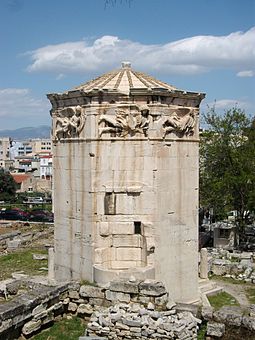
But predating that is an even older Tower of the Winds, to be found in Athens. I can do no better than quote from the Athens Tourist Information web site, viz:

Torre_dels_Vents_d'Atenes

The Tower of the Winds is found in the Roman Agora of Athens, between the quarters of Plaka and Monastiraki. This is among the most famous sights of Athens. A 12-metre-tall structure with a diameter of 8 metres, this tower has octagonal shape. It was made of fine Pentelic marble probably around 50 B.C. by the Greek astronomer Andronicus of Cyrrhus. This tower has many uses in the ancient times. It was originally constructed as a time piece, that is to estimate time, based on the position of the sun. It was also used for weather indicating and forecasting. The tower features a combination of sundials, a water clock and a wind vane. In fact, its frieze depicts the eight wind deities according to their direction: Boreas (N), Kaikias (NE), Eurus (E), Apeliotes (SE), Notus (S), Livas (SW), Zephyrus and Skiron (NW). Source: http://www.greeka.com

Celts, Silk and Druidic Knowledge

Even in the 6th century BCE there is evidence of silk being worn by the Celts in Europe. It has been found mongst the many rich grave goods discovered at Hallstatt in Germany.  The silk cloth must have felt exquisite compared to the standard wool and linen usually worn. There were many other fine grave goods discovered often imported from sites across Europe including for example coral, amber and even black shale bracelets from Britain.

The interesting point though is how extensive the trading routes were, even in the 6th century BCE, and doubtless it was not only silk and other goods that made their way across many thousands of miles. Along with the exchange of good there would be the exchange of knowledge – tales of far distant places, the religions practised there, the latest fashions even – and no doubt the traders would have been accompanied by priests and others curious to explore the worlds around them.

IMGP5257_1024

Authors, especially Peter Berresford Ellis in his book The Druids, have pointed out many similarities between what is known about the religion practiced by the Druids and that of Hinduism.  And with the evidence of trade with China as well it all paints an interesting backdrop to the religion of the Druids.  Sadly, fascinating as these connections are, we can never know the reality, but given the evidence of how far goods – and therefore knowledge – travelled who knows?

Design a site like this with WordPress.com
Get started